A gas station in Berkeley, California, showing gas rationing in January 1944, during World War II Photo by: Oakland Museum of California
By
Dorothea Lange, Oakland Museum of California
Text Type
Photo Essay
Words
552
Lexile
1010L
Published
05/01/2026
America’s entry into World War II ended the Great Depression. Lange focused on two government projects that showed different sides of the war effort. Men and women of all races worked together in California shipyards. At the same time, racist policies targeted Japanese Americans for removal and imprisonment. For both projects, Lange set out to make truthful images of the effects of the war on the home front.
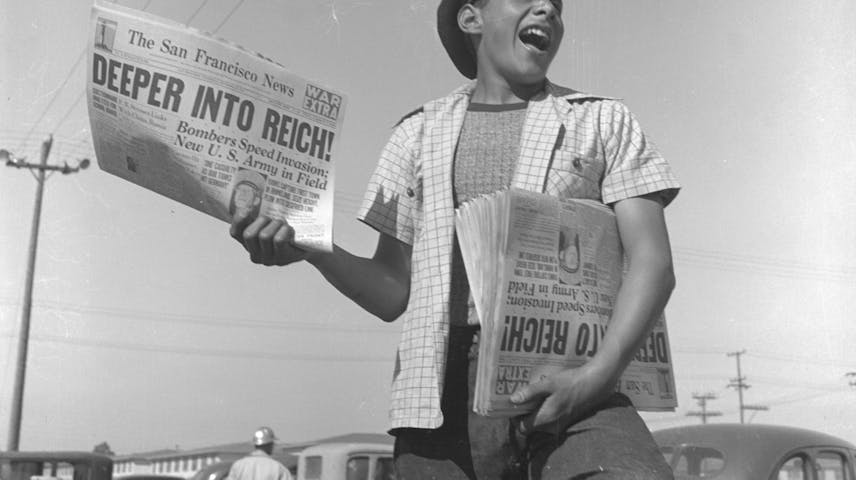
Horsemeat for Human Consumption, Oakland, CA, 1942 Photo by: Oakland Museum of CaliforniaStreet Scenes – Wartime. San Francisco, California, around 1942 Photo by: Oakland Museum of CaliforniaUntitled (Newsboy with War Headlines, Richmond, California, 1944 Photo by: Oakland Museum of California“Work for all-now-regardless of sex or race” (couple in front of 10th St. Market), Oakland, CA, Spring 1942 Photo by: Oakland Museum of California
“These were defense years, war years, shipyard years. There was overtime, and swing shifts, and graveyard shifts, and everyone in the family worked. And the migratory workers settled down and slept under a roof and the Negroes kept coming in droves, leaving the cotton fields of the South, and everyone was welcome.” — Dorothea Lange
Directions: You will examine historical photos and read a text from before the events of the book. Begin reading “Before Pearl Harbor, L.A. Was Home to Thriving Japanese Communities. Here's What They Were Like” by Patt Morrison. Start at the beginning of the article and pause when you reach the line, “How that idyll ended, I’ll get to presently.” You may read independently or follow along as classmates read aloud.
When you reach the line “How that idyll ended, I’ll get to presently,” pause your reading. As needed, review the meaning of the word idyll. Then, respond to the questions that follow to check your understanding and guide your discussion.
What traditions did Japanese people bring with them when they came to the West Coast? What American traditions did they adopt?
Continue reading the article. Pause again when you reach the sentence, “And then, beginning Dec. 7, 1941, it was all swept away.” Be ready to stop and discuss your understanding at that point.
What challenges did Japanese and Japanese American people face as they built communities in Los Angeles and other cities?
Take out the Key Terms and Topics graphic organizer. Add the terms perspective and bias to your organizer. As you add each term, write its definition so you can use it to support your understanding of the text.
Part A: Compare Media: Daily Life on the Homefront
Turn and Talk
Directions: Analyze the photos from “Daily Life on the Homefront.” As you look closely, listen for important background information about each image. Then, turn and talk with a partner to compare how the article and the photos present the lives of Japanese and Japanese American communities in the United States, including their cultural life. As you discuss, think about what each source shows, emphasizes, or leaves out, and how that shapes your understanding of the time period:
What do you understand from the article about Japanese and Japanese American communities? What do you want to learn more about?
In what ways was the response to Pearl Harbor a break with past treatment of Japanese Americans? In what ways was it a continuation?
Untitled (Newsboy with War Headlines, Richmond, California), Richmond, CA, 1944 Photo by: Dorothea Lange
Once you have observed the photos and answered the questions you will use your Key Terms and Topics graphic organizer to record important historical events, policies, and key details that help you build context for what you are learning.
Check for Understanding
Write 1-2 sentences explaining how the article and photos present life before Pearl Harbor. In your response, be sure to:
Explain one difference or similarity in how the topic is shown across the two sources.
Describe what one source emphasizes or leaves out and how that reflects a perspective or possible bias.
Part B: Preview Themes
Collaborative Idea Board
Directions: Think about the ideas of perspective and purpose. As we discuss, consider bias, representation, and what gets remembered, and why. Share your ideas as we record them on a Collaborative Idea Board, and connect your thinking to how photographs shape what people understand and remember.
Is it possible for a photographer to be biased, or do photos—assuming they are not heavily edited—merely present neutral facts?
How does a photographer’s perspective come through in their work?
Review the Essential Questions that will guide your thinking and learning throughout this unit.
How do historical records—texts, images, and testimony—shape what is remembered about the past?
How can readers evaluate words and images for accuracy, perspective, and ethical use?
Reflection
Reflect on your ability to analyze how a photographer’s perspective and purpose influence what is shown, what is left out, and how events are understood using the Reflection routine.
How confident do you feel explaining how a photographer’s perspective shapes what viewers see and remember about an event?
3–2–1 Summary
Directions: Create a 3–2–1 summary focused on the phrase “Thriving Japanese Communities.” Think about what it means for a community to thrive as you complete your summary.
3 important words/phrases
2 key details or Ideas
1 sentence explaining what the text is mostly about (gist sentence)