The Student Nonviolent Coordinating Committee is not a membership organization,
but rather an agency attempting to stimulate and foster the growth of local protest movements.
The Coordinating Committee itself consists of representatives of protest groups which meet regularly to formulate strategy. The Committee elects an executive committee, which is responsible for employing staff and overseeing the general program.
Chairman: JOHN LEWIS
Executive Secretary: JAMES FORMAN
Staff Coordinator: WORTH LONG
Communications Director: JULIAN BOND
Project Directors:
Mississippi: ROBERT MOSES
Southwest Georgia: CHARLES SHERROD
Central Alabama: BERNARD LAFAYETTE
Arkansas: WILLIAM HANSEN
Eastern Shore: REGINALD ROBINSON
Student Nonviolent Coordinating Committee
8 1/2 Raymond Street, N. W., Atlanta 14, Georgia
Telephone: 688·0331
We, the . . . students who comprise the staff of the Student Nonviolent Coordinating Committee, and the thousands who form its foundation, have staked our lives on the conviction that an interracial democracy can be made to function in this country, even in the fields, bayous, and deltas of the deep South.
We have not spared ourselves in attempting to make that faith reality. We call upon the federal government to do likewise. We would have it understood that we are not calling on the nation for what she might do for us, but rather to inform her of what she must be prepared to do for herself.
... from SNCC testimony, before the House Judiciary Committee, May, 1963
HISTORY
The Student Nonviolent Coordinating Committee emerged from the historic sit-in movement that swept across the South in the spring of 1960. During the Easter season of that year, the first region-wide assembly of sit-in leaders was convened in Raleigh, North Carolina.
A temporary committee was established here to foster communication and coordinate the activities of protest groups. This body met monthly throughout the summer, established an office in Atlanta, and prepared for a second conference held in October 1960.
At this meeting, the Student Nonviolent Coordinating Committee was formally organized. Representatives from each Southern state and the District of Columbia comprised the Coordinating Committee. Participation in the 1961 Freedom Rides and a growing awareness of the profound fear shackling the South convinced SNCC leaders that someone would have to carry the freedom movement to the millions of exploited, disenfranchised, and degraded Negroes of the Black Belt.
SNCC DID JUST THAT.
August 1961—SNCC launched its inaugural voter-registration project, choosing
Walthall, Pike, and Amite Counties of Mississippi. This sparked nonviolent direct
action by hundreds of high-school students in McComb, Mississippi, and led to the
development of a statewide voter-registration program. This struggle was recently
dramatized by the use of snarling police dogs to obstruct Negroes from registering
in Greenwood, Mississippi.
October 1961—SNCC workers entered Albany, Georgia, becoming the catalytic
fuse for the massive protests known as the Albany Movement.
By November 1961, sixteen students had volunteered to leave school for a year or
more to work in the hard-core rural areas for subsistence wages only.
PROGRAM
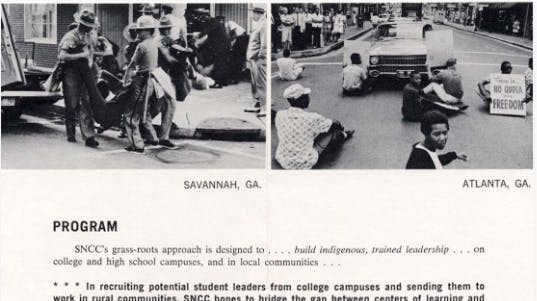
SNCC's grassroots approach is designed to stimulate protest on college and high school campuses, and in local communities … build indigenous, trained leadership … on
* * * In recruiting potential student leaders from college campuses and sending them to work in rural communities, SNCC hopes to bridge the gap between centers of learning and the work-a-day communities.
* * * SNCC workers have organized and guided local protest movements which are never identified as SNCC projects. This is part of its program of developing, building, and strengthening indigenous leadership.
This program has captured the imagination of students all over the country. And today, more than 150 SNCC field secretaries are symbols of courage and dedication as they undertake the often tedious and tiring, and always dangerous work, in the most difficult areas of the South . .
MISSISSIPPI—SOUTHWEST GEORGIA—CENTRAL ALABAMA—EASTERN ARKANSAS—SOUTHERN VIRGINIA
These students work for subsistence wages when funds are available, but at times they have
chopped cotton and picked squash to secure food. They live in the community, often in the homes of local residents, for the weeks and months that are required to break through generations of fear and intimidation. The students' courage helps emerging leaders achieve a new self-image and the strength to act. Sustained personal contact, discussion and persuasion and his determination to stay with them and their problems, give the local people confidence in the SNCC worker and the program he advocates. The people then begin to gain enough confidence in themselves to seek and assert their rights. In the community SNCC workers organize for voter registration and direct action. SNCC voter registration efforts give disenfranchised Negroes the right to vote in areas where they have been denied this right since Reconstruction. And, fully as important, the program deepens an awareness
of the meaning of first class citizenship, develops a community of action, and creates mutual trust among people who too often have been suspicious and divided by fear. As of summer, 1963, SNCC had initiated and participated in . . . . direct action campaigns in 49 cities in 13 states.
THE FUTURE ...
The future means redoubled efforts to continue . . .
introducing educated and determined young workers into hard-core areas;
maintaining a college contact that leads to militant action in cities and provides new recruits for full-time work.
The future means . . .
expanding our pilot voter registration projects in cities to provide workers in surrounding counties.
finding more funds to support students willing to work at subsistence wages and share the life of the Southern rural Negro while trying to convince him of his rights.
providing more and better workshops and conferences on the meaning and techniques of nonviolent community action and political involvement.
Change will be slow, but change must take place. SNCC will need three times our current staff to do the job we have only begun. We will also need three times our current budget.
The future means your support . . .
in contributions and in stimulating your local community to break down every form of racial discrimination now.
in letting us know how we can help you and how you can help us.
DANVILLE, VA.
WE BELIEVE AND WE ASK YOU TO BELIEVE WITH US: WE SHALL OVERCOME!