FROM THE VAULT: The Boy From Troy—How John Lewis Empowered America
Our story begins with the chickens. Sixty or so in all—Rhode Island Reds, Dominiques, and bantams—each of whom contributed to the collective clucking within the henhouse on Eddie and Willie Mae Lewis’s farm. This was in Pike County, Alabama, near the city of Troy. Cotton country. A land of kudzu-lined red clay roads and plenty of poverty, too.
Yet by 1944, the Lewis family was doing better than most of the county’s Black residents. After years of sharecropping, Eddie Lewis used $300—the bulk of his savings—to purchase the 110-acre farm, upon which sat their three-room home, a smokehouse, an outhouse, and what, for four-year-old John Robert Lewis, seemed the holiest place of all: the henhouse.
The windowless pine-planked structure was small, dusty, and reeked of chicken manure. Yet its condition did little to deter young Lewis from fulfilling his duty as the newly appointed caregiver for the family’s brood.
Beginning in the spring, Lewis would rise with the sun, make his way to the hen house, unlatch the door, and step inside. Chaos inevitably ensued.
“I’d speak softly, gently, as if I were hushing a crying baby,” Lewis wrote in his memoir, Walking With The Wind, “and very quickly the cackling would subside, until finally the shed was as silent as a sanctuary.”
By nightfall, the hen house would transform into a literal sanctuary. After returning the chickens to their roosts, Lewis reached for his Bible and preached to those birds.
Of course, if you know anything about the mythos of John Lewis, then surely you already know this. But what you might not know is that in addition to the preaching, five-year-old Lewis performed bird baptisms and burials too. Not to mention caring for their earthly needs as well. For young Robert (as he was known then), it wasn’t just about saving their souls, it was about improving their lives. Though the rest of the family viewed the chickens as the “lowest form of life on the farm,” Lewis saw them as “God’s chosen creatures.”
“Maybe,” he reflected years later, “it was that outcast status, the very fact that these chickens were so forsaken by everyone else, that drew me to them.”
In the fall of 1957, seventeen-year-old John Lewis bid farewell to his chickens and boarded a bus to Nashville’s American Baptist Theological Seminary. It was a long way from Pike County, not just geographically, but culturally, too.
“I was just a boy from the woods,” Lewis wrote, “nervous and unsure.”
Soon, he’d befriend future civil rights leader James Bevel and others, though his first meeting with Dr. Martin Luther King in the summer of 1958 had the most lasting impact. As Lewis tells it, Dr. King, Rev. Ralph Abernathy, and attorney Frank Gray met him in the basement library of Montgomery’s First Baptist Church.
“So you’re John Lewis,” Dr. King said. “The boy from Troy.”
This is where the story diverges. According to Lewis’s memoir, he was so intimidated by the presence of the men that he couldn’t manage much in the way of reply.
But according to Dr. Rip Patton—a fellow Freedom Rider, and a friend of Lewis’s—John Lewis, indeed, managed to string a couple of words together.
“No sir,” Lewis allegedly corrected Dr. King. “I’m actually John Robert Lewis.”
Imagine the scene. How eighteen-year-old John Robert Lewis found it easier to believe that another John Lewis from Troy happened to have arranged a meeting with Dr. King, rather than the alternative version: that he himself was that man.
It would be a hard story to swallow if it didn’t seem so fitting to his personality.
Who but a chicken preacher, after all, could possess such humility?
Three years later, Lewis again found his way to Montgomery’s First Baptist Church. Though this time, he was no longer the wide-eyed burgeoning freedom fighter, but a clear-eyed veteran of the movement. His humility remained, but reality had rattled him.
The previous day, May 20, 1961, Lewis and several Freedom Riders had taken a bus from Birmingham to Montgomery to test a pair of Supreme Court rulings involving the unconstitutionality of segregation in interstate travel. Upon their arrival at the Greyhound station, the riders were severely beaten. Lewis was knocked unconscious by a Coca-Cola crate slammed against his head.
The following day, Lewis and the other Freedom Riders took refuge in the church basement as King flew in from Chicago to join them. That afternoon, King and Lewis reunited in the place where they’d first met. This time, no introductions were necessary.
While King’s presence served as a show of support for the Freedom Riders, it also ignited the white mob just beyond the church doors. Molotov cocktails sailed into the church as Lewis and others watched the sanctuary fill with smoke. It was only under the protection of the Alabama National Guard that the Freedom Riders were whisked from the church and delivered to the home of Dr. Richard Harris Jr.—a Black pharmacist, who also happened to be former neighbors with King.
Valda Harris, Harris’s daughter, walked downstairs that Monday morning to notice her home filled with Freedom Riders. Valda Montgomery (as she’s known today) recently explained that this wasn’t all that out of the ordinary. The Harris home regularly served as a gathering place for civil rights icons and activists. Not only were members of the King family regular guests, but so were Joseph Lowery, C. T. Vivian, James Farmer, James Lawson, James Bevel, and Diane Nash, among others.
The Harris’s living room served as a “Who’s Who” of the civil rights movement, and following that May night, John Lewis’s name was added to its list of illustrious guests.
Yet thirteen-year-old Valda Harris had never heard of John Lewis. Still, she remembers him standing out among the others, not due to his rising star, but because of the large white bandage atop his head.
After two days of violence, the Harris home provided the riders with a much-needed reprieve. When they weren’t strategizing, they were laughing, dancing, and breaking bread together. Memorably, Lewis shared his first beer with Harris in the Harris home—an occasion Lewis noted in his memoir Walking With The Wind.
Decades after that drink, Valda Harris Montgomery approached Congressman Lewis at his book signing.
Their eyes met, and as Lewis scoured his mental Rolodex to recall how he knew her, she offered him a hint.
“I’m the daughter of the man who gave you your first beer,” she smiled.
Lewis rose from behind the table to embrace her.
In late May 1961, just days after leaving the Harris home, Lewis and his fellow Freedom Riders arrived in Jackson, Mississippi, where they were arrested, transported to jail, and sent to Parchman Penitentiary, which Lewis described as “essentially a 21,000-acre twentieth-century slave plantation.” For weeks, Lewis shared his cell with fellow Freedom Rider Bill Harbour. Originally from Piedmont, Alabama, after being denied entrance to Jacksonville State University, Harbour attended Tennessee State University, where he became involved in the Nashville movement. In his memoir, Lewis describes Harbour as small in stature but large in personality. Lewis remembered, too, that Harbour held him and the other Nashville veterans “almost with awe.”
“If John Lewis said go,” Lewis wrote, “Bill Harbour was ready to go.”
Four years before his death in August of 2020, Harbour shared with me what it was like being in such close quarters with Lewis during their weeks together in a cramped Parchman cell.
“You get pissed off, you hug, you raise hell,” Harbour chuckled. “I couldn’t say too much because John was a minister—going to theological seminary—so I couldn’t cuss too damn loud.”
Lewis’s faith ran deep, and while Harbour’s did, too, the latter struggled to interpret the Bible as literally as the former. Hoping to change that, Lewis—the famed chicken preacher from Troy—took advantage of his captive audience.
One day Lewis cracked wide his Bible, recounting to Harbour the story of Shadrach, Meshach, and Abednego, all of whom refused King Nebuchadnezzar’s order to worship a golden idol and were imprisoned and hurled into a furnace as a result. But the Lord spared them, prompting the king to acknowledge his own false worship.
In the retelling of the story, Lewis remarked how God had flung wide the jail doors, freeing the imprisoned men.
“Now wait a minute, John,” Harbour said, interrupting Lewis mid-sermon, “if you believe that, then why aren’t our doors flying open so we can get the hell out of here?”
Harbour had him there. However, in a matter of weeks, those prison doors would be flung wide. Once they were, Harbour would leave that cell with one less hero to worship and one more man to call his friend.
Eight-year-old Sheyann Webb was playing outside of Selma’s Brown Chapel on that fateful January day in 1965 when she noticed eight or nine cars rumbling to a halt before the church.
“I saw all these men getting out of the first two cars,” she later recalled, “and I saw them surrounding themselves around one particular man. When I got closer to them, one of the men among the entourage said, ‘Do you know who this man is?’”
“That man,” the member of the entourage said, “is Dr. Martin Luther King.”
Hours later, Webb met King directly. Impressed by her interest in the movement, King took note of the young girl whom he would later dub the “smallest freedom fighter.”
“There’s going to be a movement coming to Selma,” she remembers King telling her, “and I want to see you here when I come back here.”
Webb stuck close to the church for several hours, anxious for another glimpse of the men who’d come to town. By day’s end, she’d cross paths not only with King, but also with Hosea Williams, Rev. Ralph Abernathy, and twenty-four-year-old John Lewis.
“So, what’s your name?” Lewis asked her.
She told him.
“Well, I’m going to call you Shy,” he said. “Are you shy?”
She assured him she wasn’t.
He smiled.
“Well, I know you’re a smart little girl,” Lewis said, “and I know we’re going to see you when we come back to Selma.”
He was right about that.
In the months leading up to the March 7 Selma to Montgomery March—a day now known as Bloody Sunday—Webb became a fixture at Brown Chapel, even skipping school on the days she knew King, Lewis, and other freedom fighters would be in town.
“It wasn’t ordinary that a child would even want to [get involved],” she said. “But I did. And I thank God that I had the opportunity to be that disobedient child. Back then,” she laughed, “I didn’t know I was getting into good trouble.”
Neither did Webb’s parents, who were less-than-supportive of their daughter’s involvement with the movement.
To ease tensions on the home front, Webb regularly asked various activists to walk her home. Lewis became one of her escorts, as did civil rights photographer Jim Peppler. On one occasion, Viola Liuzzo—a housewife and civil rights activist from Detroit—walked her home as well. Liuzzo was killed weeks later, shot by a Klansman in retribution for her civil rights work.
Webb’s parents were right to worry. If the Klan was willing to kill a white woman from the North, what kept them from killing their daughter?
Still, the smallest freedom fighter could not be deterred.
“I was taught to stand up, and I was taught early,” she explained. “Everything that John Lewis is encouraging people to do now, he was encouraging me to do back when I was seven.”
In February of 1965, nineteen-year-old Arione Irby, a native of Gee’s Bend, Alabama, made the trip to Selma so that he, too, could join Lewis on the fifty-four-mile march to Montgomery. Decades later, at age seventy-four, Irby recalled how he visited Selma on the days leading up to the march as well, taking his place in the pews at Brown’s Chapel as emotions remained high in the aftermath of the police murder of Jimmie Lee Jackson, a Black veteran from the nearby city of Marion. While voting rights had previously served as the primary motivation for the march, Jackson’s death provided demonstrators one more reason to take to the streets. As the mass meeting attendees grappled with the proper response, as well as the possible ramifications of implementing a march of such magnitude, Irby recalls Lewis arguing for bold action.
“Let’s just put it together and do it,” Lewis told the crowd. “If all of us get killed on that bridge,” Lewis continued, “that means some other people will get to live and enjoy the freedom that we brought.”
“I was not ready to die when I walked on the Edmund Pettus Bridge that Sunday morning,” Irby told me. “But I was prepared to give my life that day for you today. Because we would have never made it to this day had it not been for that day.”
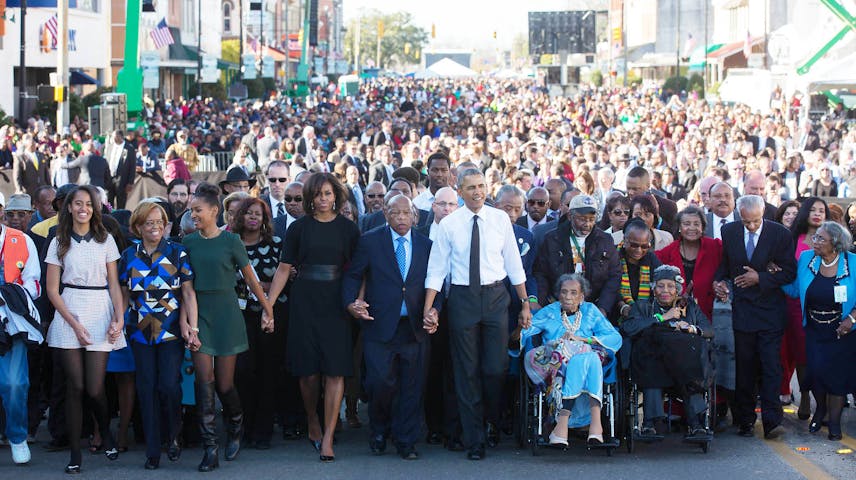
On the morning of the march, Webb took her place near the back of the demonstrators, while Irby stood close to the front. Lewis, decked out in his beige trench coat and backpack, led the demonstrators alongside Williams.
The now infamous film footage captured what happened next. How the mounted state troopers held their nightsticks at the ready as the demonstrators approached. When it was clear the demonstrators had no intention of turning around, the troopers attacked, shoving them to the ground and releasing tear gas throughout the crowd.
Within moments, Irby lost sight of Lewis and everyone else. Irby was knocked down, trampled by horses, and blinded by tear gas.
“When that tear gas hit me, my mother was at home in Gee’s Bend, praying for me,” Irby said. “And I could see her face. And she said to me, ‘Son, you are not going to die.’ In that vision, when I was tear-gassed to where I couldn’t see nothing, she said, ‘You’re not going to die.’ And I didn’t,” he says proudly. “And I’m still here today.”
In 2011, when graphic novelist Nate Powell was enlisted to collaborate with Lewis and Andrew Aydin, Lewis’s digital director and policy advisor, on March—a three-part graphic novel memoir tracing Lewis’s personal story alongside the backdrop of the larger civil rights movement—he immediately recognized the daunting nature of the task. Powell dedicated a year to research and script work before meeting the congressman face to face.
“Not really knowing how to handle the situation, I dressed up in a three-piece suit on a 90-degree day,” Powell laughs, “so things got very sweaty very quickly.”
But the combination of warm weather and wardrobe were the only causes of Powell’s discomfort.
“It immediately hit me how quietly dedicated [John Lewis] was to putting me at ease and sort of dispelling any sense of pecking order or celebrity or anything like that,” Powell explains.
That afternoon, Powell, Lewis, and Aydin toured the capital grounds.
“I very quickly got a crash course on how a lot of interactions with the congressman go,” Powell chuckled. They could barely make it twenty feet before one of Lewis’s admirers would inevitably reach for the congressman’s hand, ask for a photo, or break into tears on the sidewalk.
Since Lewis had a moment for everyone, the tour extended well beyond the allotted time.
“Get used to it, man,” Aydin told Powell. “This is just the way it’s going to be.”
Though the graphic novel may have seemed an unlikely medium to recount Lewis’s civil rights story, it’s hardly without precedent. In 1957, the Fellowship of Reconciliation (FOR) published a sixteen-page comic titled Martin Luther King and The Montgomery Story. The visual format aligned perfectly with a key demographic—young people—and served as the inspiration for the March trilogy, which is regularly taught in schools today.
Moreover, Lewis had great respect for the form.
In 2015, Lewis, Powell, and Aydin attended Comic-Con International in San Diego. Powell appreciated the congressman’s willingness to participate in an event so far outside his wheelhouse. Yet Lewis embraced the experience fully, more so than anybody could have imagined.
On the morning of their panel, Powell, Aydin, and Leigh Walton, their editor, knocked on the congressman’s door.
“Come on in, boys,” Lewis called.
They stepped inside to find Lewis putting the finishing touches on his cosplay costume. He’d dressed as himself fifty years prior—complete with a beige coat and backpack similar to those he’d worn while crossing the Edmund Pettus Bridge.
“What are you doing?” the others asked.
“Well,” Lewis said, reaching for his backpack, “when I was arrested on March 7, I had an apple, an orange, a toothbrush, toothpaste, and two books. So I brought all those things today.”
Nate Powell chuckled at the lunacy of the scene: how a US congressman and one of the foremost leaders of the civil rights movement found himself completely caught up in the finer details of his cosplay costume.
“What’s amazing,” Powell laughed, “is that no one’s going to look in his backpack. But he wanted the experience to be complete for himself.”
Lewis’s meticulousness was hardly limited to cosplay. Freedom Rider Charles Person remembers observing that same trait upon first meeting Lewis at the Fellowship House in Washington, DC, in May 1961, in the days leading up to the first wave of Freedom Rides.
“John’s things were always in order,” Person remembers. “It stood out because it was so unusual. When you’re on a college campus at that age, you’re usually not quite together.”
But Lewis was different, Person explained. Because whether he was planning a protest or packing his luggage, Lewis knew precisely what was necessary, and he was capable of carrying it out.
Such single-mindedness served Lewis well throughout his political career, allowing him to remain focused on the issues rather than grow embroiled in distraction.
“How can you even survive an environment like politics without some scandal?” Person asked. “It’s just remarkable that someone could maintain their character through all of those associations in politics.”
One of the main differences between Lewis and other politicians was that Lewis seemed more fully at ease with himself. He wasn’t afraid to get goofy. Or dance. Or allow his authenticity to emerge. Person remembers how, early in Lewis’s political career, a radio personality in Atlanta regularly gave the young congressman a hard time for wearing “J. C. Penney” suits rather than the high-end fashion designers other politicians preferred.
“John was just practical,” Person said. “He dressed well, but he didn’t have that Julian Bond look. He didn’t have that GQ quality. That just wasn’t John.”
Throughout Lewis’s life, humility was always his style. He was as pleased participating in a march as leading one. While he didn’t mind the spotlight, he didn’t mind redirecting it, either.
During the annual Selma Bridge Crossing Jubilee—a march commemorating Bloody Sunday—Lewis and Sheyann Webb-Christburg regularly regaled the crowd with their stories.
“The last time he was here was in March 2020. He was very sick and weak and frail,” Webb-Christburg said. “But he still came up and gave me the mic and wanted me to tell my story.”
Powell recalls Lewis responding similarly throughout their many speaking engagements for March.
“At every single turn, when [Lewis] realized the interviewer was just seeking to get good quotes about John Lewis and John Lewis’s story…he just wouldn’t have it. He would very politely and calmly diffuse the focus so that we were constantly being brought back to a collective scenario, [reminding them] that this was the work that the three of us had done together.”
In addition to giving credit to his collaborators, Lewis also insisted that the pages of March extend beyond his personal story.
“It became increasingly important to us as the story expanded to illuminate a lot of figures who have sort of been shoved under the rug over the years,” Powell said, “many of them being Black women, or being gay, or people who had been marginalized in the pages of history.”
March was Lewis’s chance to acknowledge them, too. And to remind readers of what many forget—that the civil rights movement was larger than Dr. King and Rosa Parks. And most certainly, it was larger than John Lewis, too.
In life, Lewis excelled at passing the mic, but even in death, he’s doing it. Try as I might to write an abridged version of Lewis’s life, I can’t stop writing about his friends. Which is just the sort of “problem” that might’ve made Lewis smile.
The John Lewis I’ve come to know didn’t have time to embrace the hero status we’ve thrust upon him. Not when there were chickens to preach to, bridges to cross, buses to board, books to write, and young people to inspire.
On the day of his funeral, Lewis—activist, politician, author, cosplayer, chicken preacher—added another title alongside the rest: guide. In a New York Times op-ed written just days before his death, he offered a roadmap to lead us to the Beloved Community—a phrase popularized by Dr. Martin Luther King and which spoke aspirationally of a society in which peace, justice, and equal opportunity reigned supreme.
“Ordinary people with extraordinary vision can redeem the soul of America by getting in what I call good trouble, necessary trouble,” Lewis wrote.
Of course, he might’ve been speaking of himself, the original troublemaker. And the person who inspired Rip Patton, Valda Montgomery, Bill Harbour, Sheyann Webb-Christburg, Arione Irby, Charles Person, and Nate Powell to stir up a little good trouble themselves.
Throughout his life, Lewis did more than rise up, he rippled out. In doing so, he empowered us to believe that we could all be the boy from Troy, the girl from Selma, or the man from Gee’s Bend.
He taught us that no chicken is too small for salvation, and no nation too great to receive the same. He taught us, too, never to let despair be our destiny, but to be defined by defiance instead.
If you, like me, are still searching for John Lewis’s legacy, search no further. His legacy is us.
About the Author
B. J. Hollars is the author of several books, including Go West Young Man: A Father and Son Rediscover America, The Road South: Personal Stories of the Freedom Riders, and Opening the Doors: The Desegregation of the University of Alabama and the Fight for Civil Rights in Tuscaloosa.